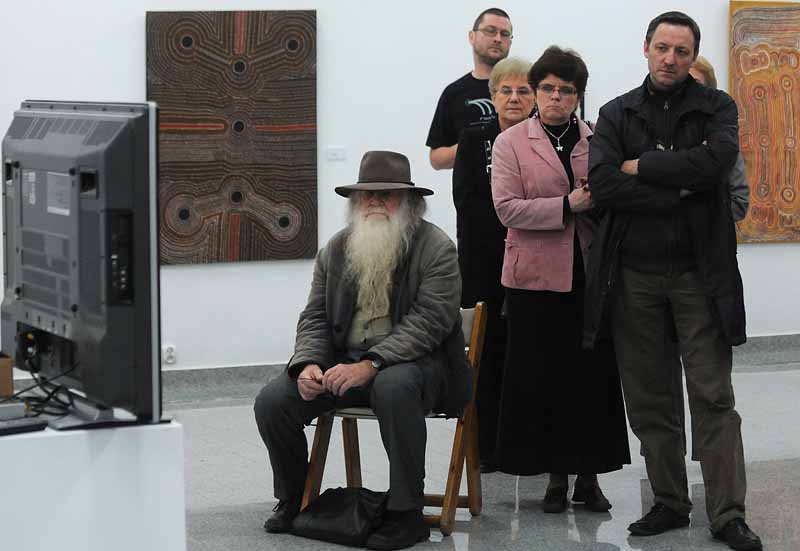
| Galeria bwa, in 5th Mozg Festival, International Contemporary Music & Visual Arts Festival, Bydgoszcz, Poland |
|
What to say about art? What to say about art that comes from afar? What to say about that far off that I myself come from? Each painting is a story. It is triggered by story - an encapsulated event. It is story. In re-enacting the story it is story itself; in enacting event it is event itself. This puts a curious burden on the viewer for it represents a demand. There is no ‚take-it-or-leave-it‘. It wants to seize you by the throat, it wants to put you there. It wants to make you a participant. You are not merely spectator. If the event is to live, if the event is to continue to resonate, it must be through your body. There has to be an actual transfer. The conviction of the artist is not enough. The sincerity of belief has somehow to be ‚transformed‘ via the sincerity of the image. How does this work? You will only see it if you see the face of the artist in their own painting, sitting patiently, sitting cross-legged ready to speak, waiting to sing, waiting to touch with the tips of the fingers drawn somewhat together, gathered together as if posing a question. As if to say, ‚It is there, there it is, it is there‘. A painting is a skin you can wrap yourself in. And if a thing to enclose you – no, not to adorn – then equally a thing to peel from yourself, layer by layer, the whole inscribed surface of yourself, from deep inside to that pre-appearance of self that hovers just above the surface, or appears in advance of its own appearance. A pre-appearance, as it were, rather than a trace. For if you are the one that makes the mark you exist in advance of the mark. The mark is more or less by way of confirmation. If the mark is no good, if the mark is perfunctory, you too are no good, you too are perfunctory. The mark has to be felt as if for the first time. The note is played in advance of the note; it creates an expectation. And if the note meets the expectation we are encouraged to persevere, to yield ourselves up, not exactly in a trusting way, but understanding that we are in the presence of something necessary; that existed before we did; that existed before any of us did. Some people may call this The Dreaming, or The Dreamtime. Others may call it The Law, or even just The Beforetime. Law is good for it suggests something necessary, something like a necessary upheaval that has been waiting to happen. Of course there is much bad art. And bad art is an abomination. Can history be felt from outside? I’m not sure I understand my own question. I suppose I mean life has to be felt. It cannot be lived on the outside or by proxy. This is trite and true. The question that has to be asked of Aboriginal art – the best of it – is the experience of life, of being, that it springs out of. It is perhaps no accident that the best work comes from those who are already old – those who have experienced, those who remember, those who live a life of secret understandings, perception coupled with perception, unexpected affinities, sly awarenesses, the secret life, the secret history of all that appears. How odd that that history should, in some transmuted form, end up in a far off place, where none of the known makes any appearance whatever. It try to imagine a gallery of Polish art somewhere in Australia. It may exist, I doubt it very much. Even a collection of Polish art. No, it borders on the unimaginable. So here we are in the presence of a little miracle – and like all miracles something of an oddity. It is odd, it is disconcerting. That’s good. It looks like Aboriginal art, it is Aboriginal art, and best of all it is not trying to be Aboriginal art. The latter takes us to the folkloric – and that is the kiss of death. There is a lot of Aboriginal art in this sense and I have no time for it, even as an oddity (which it surely is). I should have brought a gift. I thought about it. I couldn’t think what it might be. I thought of catalogues; I thought particularly of the catalogue of Aboriginal bark paintings from a recent show at the MCA, Sydney. It had this plus: both Djon and I contributed to it. This speaks to a set of social relations - Djon and my friendship, but also our long engagement in different parts of Arnhem Land, him in the east, me in the west. He was there for art; I was there for other reasons. Social relations are at the heart of Aboriginal art, and the actions of the ancestors. Human actions, in short, human agency, its potential, its risks, its consequences. Responsibility. How to make sure a collection remains a set of social relations? How to stop it turning into a set of things. Even worse, a set of curios. This is the question – and the challenge – that Aboriginal art poses: the necessity to maintain the centrality of the social. Dr John von Sturmer 17 11 2009 Phillipine Sea 39 000 feet
|